Friday, September 24, 2010

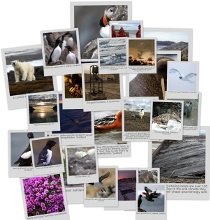
Photos from the field season 2010


All my albums in Picasa are finally updated with fresh photos from field season 2010. You can check them out here.

Read more...

Thursday, September 23, 2010

Forskningsdagene


Forskningsdagene is a popular scientific event arranged once a year in Norway. The idea is that institutions are presenting their research for interested public. I think this is a great idea, since the public is often funding our research. Only problem with the event is that the "big names" are not having time to talk to the mortals. The task is often given for younger people. Well, on the other hand it's great fun for us and maybe we are as able to show scallops for kids as any experienced researcher...

This was my second year with Forskningsdagene. My input for popular science this year was to take part for a cruise to Senjahopen with the University's research vessel Johan Ruud. This was also my first time, and probably the last for a long time, as a cruise leader. We went to show marine organisms for school kids on Senja. The science was not that interesting after all, but they found it incredibly entertaining when a sea cucumber was "pissing" on their pants...
Tomorrow we will anchor the boat to the harbour by Stortorget. The show starts at 11 o'clock. Come to check out where the sea cucumber pisses...

Read more...

Wednesday, September 22, 2010

No Health-Care for a Beaten Bird

In nature unexpected events follow each other. Many times observing nature is possible only, when you manage to forget observing yourself. Patience is the number one gift of a nature observer.
Guillemots seem to be a bird-world equivalent to people from India. The huge density of breeding colonies forces the birds to give an impression of compliant sitting next to each other, but real life in the colonies is often unlike the impression. Fights do occur. Fighting starts with slight pecking and sometimes develops into a serious attempt of murder. Most serious matches are solved in the air and finally end up into the ocean, where the weaker party is trying to escape by diving, flying, swimming and splashing from the murderous rage of the strong.
Sometimes Brünnich’s guillemots are bleeding after fighting, but I have never before seen any serious damage due to these fights. When counting birds in vicinity of tens of thousands of guillemots, probability of seeing rare occasions is higher. This combatant lost his fight and came to look for refuge from us, while swarming glaucous gulls were waiting to attack the beaten bird. There was not much we could do, except for taking photos. Finally we had to leave and the bird ended up as a meal for the hungry glaucous gulls. To live is to die. 

Read more...

Friday, August 27, 2010

A Bivalve Challenge


Some words about my work this time. As said, I am working with marine bivalves. The first and foremost challenge in the PhD student life, compared to my former jobs, is the freedom. Ok, I have supervisors, who are trying to keep me on the right path, but still there are so many ways to go. Asking me "what are you exactly working with?" is a bad idea. I hardly know it myself. Projects are numerous. Maybe some of them gives results in the end.
Lisää kuvateksti

Right now I am trying to find out the most effective ways to take samples. Since I need quantitative (=sampled area of seafloor is known) samples for bivalve population study, I have been experimenting with an under-water suction pump. Playing with the pump is turning out to a success and I even got my first useful sample. With the sample became another challenge: which species are these guys? Unlike with crustaceans, there is no really descriptive literature on mollusc shells. One just have to ask around and look for photos on the internet and in old books.


Lisää kuvateksti
In addition I am writing a funding application to study growth band formation in bivalve shells. These growth bands can be used as archives to study past climate and the variability of conditions between sites. First we have to find out in what kind of conditions various elements and isotopes are deposited into the shells...
Lisää kuvateksti

Read more...

Thursday, August 26, 2010

A fishless fishing trip to Senja

Sunset somewhere at the "yttersida" of Senja.
Should not write only about Svalbard all the time. So here comes something quick about my free time activities. Senja is the next island south from Kvaløya. It offers almost everything for outdoor activities all the way from climbing to hunting, fishing or diving. Last weekend we went for a fishing trip to some lakes in the mountains on the island. The trip did not offer that much fish, but great time in the nature anyhow. On the way back we stopped for a dive. Visibility was not that great, but the site is amongst the best I have been diving around here.

Mytilus (blue mussels) collected under the wharf were not poisonous after all, although you shouldn't eat those from the inner coast at this time of the year. These bivalves are filter-feeders and may accumulate algae toxins, which can contain some fairly serious stuff. The bivalves were collected close to the open ocean and the risk to get sick is fairly low. It's called exiting eating, like fugu, either you brag that you survived or then you'll die.

Mefjordbotn, one of the most spectacular nature diving sites in the area

Read more...

Wednesday, August 25, 2010

Photo of the Day - The Isle of Hope

Hopen (eng. The Isle of Hope) is one of those miserable islands surrounded by a cold ocean. During summer sunny hours on the island can be counted with fingers of one hand and the record of continuous fog is about three months. Considering these facts, we were quite lucky to see the island at all, although we spent a week anchored next to it.

Read more...

Tuesday, August 24, 2010

Photo of the Day - Great Skua


The great skua is "the predator" of Svalbard bird life. In addition to bird chicks and eggs their diet consists of adult birds, such as kittiwakes, eiders and little auks. The eagle like look is not a coincidence... 

Read more...